
As a professional gamer, I've spent countless hours exploring digital landscapes, but the experiences that truly stick with me are those that build upon themselves. In 2026, the gaming landscape is saturated with isolated adventures, but I find myself constantly drawn back to the rare, precious few series that dare to weave an overarching narrative across multiple open-world titles. These aren't just individual games; they are chapters in a grand, living novel where my actions in one world echo into the next, creating a personal history that feels uniquely mine. For me, these interconnected sagas are like a masterfully aged wine library—each bottle tells its own story, but together, they reveal the full character of the vineyard. Let me take you through the worlds that have defined this experience for me.
🏰 The Gothic Legacy: From Prisoner to Legend
My journey into connected open worlds began in the harsh, unforgiving mining colony of the Gothic series. Being thrust into that medieval war between humans and Orcs felt less like starting a game and more like being thrown into a deep, murky well with only my wits to climb out. The first game was my prison, a world of grime and tyranny under a king who saw me as mere labor. Climbing its power curve was as satisfying as watching a gnarled, ancient tree finally bear fruit after decades of patience. Gothic 2 was my key, swinging open the gates to the broader world outside. Together, they form a classic duology where my character's growth from a nameless prisoner to a force of nature felt earned in a way few modern RPGs replicate. While Gothic 3 shifted to a more vibrant tone, for me, the heart of the series will always be that raw, interconnected struggle for survival and identity.
🐉 The Eternal Song of Tamriel: The Elder Scrolls
No discussion of interconnected lore is complete without The Elder Scrolls. Tamriel isn't just a setting; it's a character in its own right, a living, breathing entity that remembers every dragon I've slain and every Daedric Prince I've (foolishly) bargained with. While each game offers a self-contained story, playing them is like listening to a centuries-old epic poem—each stanza (game) is beautiful on its own, but the true magic lies in how they rhyme and reference each other across the Four Eras. The conflict between the Thalmor and the Empire, the ever-present machinations of the Aedra and Daedra—these are threads in a tapestry so vast, my actions in Skyrim feel like whispers added to a chorus that began in Arena. The lore here is a deep, dark ocean, and I'm just a sailor charting its surface, knowing ancient leviathans of story stir in the depths below.
🕷️ Swinging Through Earth-1048: Marvel's Spider-Man
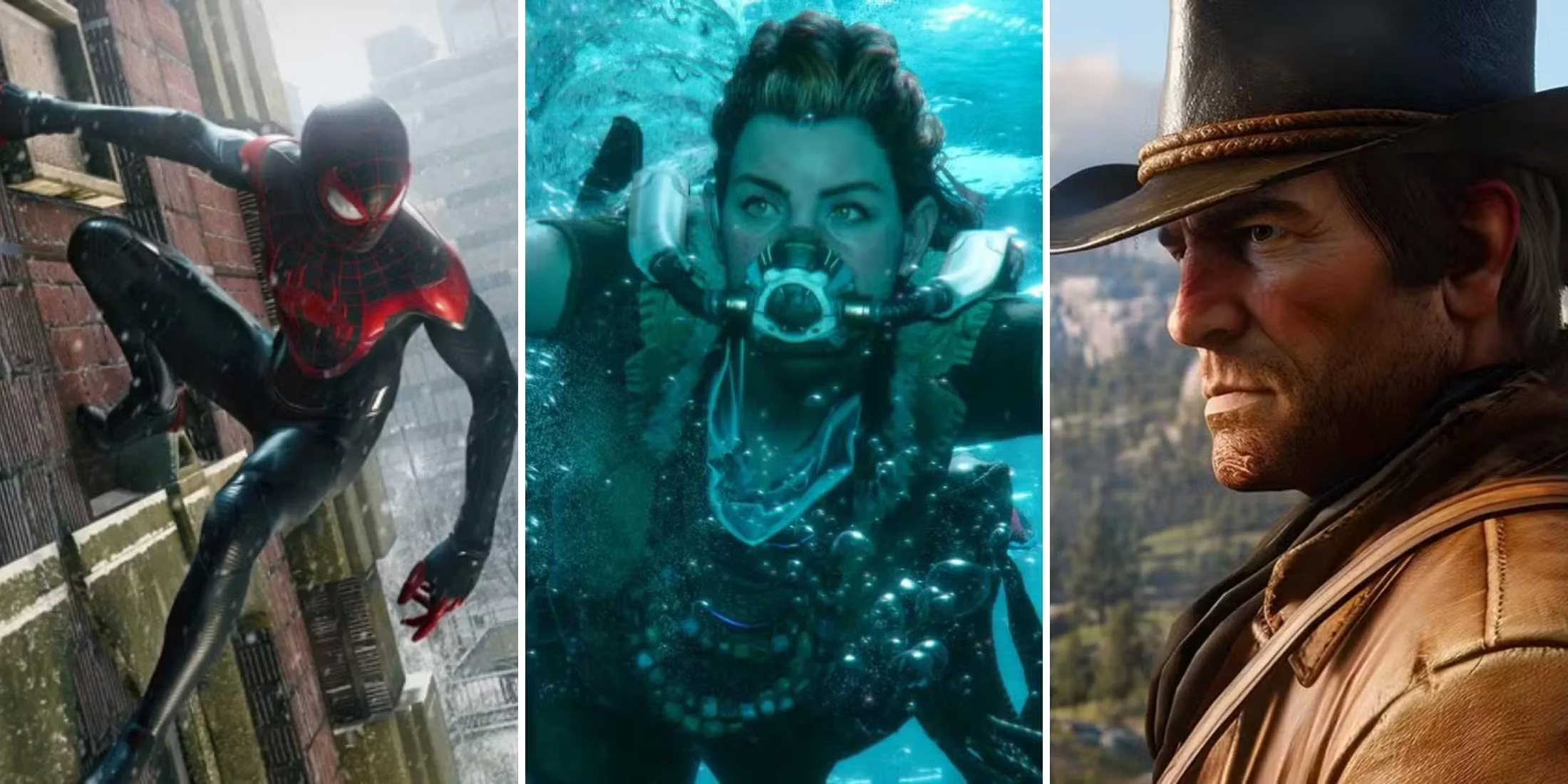
Insomniac's Marvel's Spider-Man series gifted me with something special: the feeling of growing up alongside a hero. Starting with a mature Peter Parker in 2018's masterpiece, I swung through a New York City so gorgeously realized it felt like home. Then came Miles Morales, whose journey in 2020 added a vibrant new melody to the symphony. By the time Marvel's Spider-Man 2 arrived, I wasn't just playing a sequel; I was returning to a neighborhood I helped protect, to friends whose lives I'd touched. The continuity in Earth-1048 is seamless. The fallout from one game's events becomes the foundation for the next, making my role as the hero feel consequential. It’s a superhero saga told across years, both in my time and Peter's, and that investment is priceless.
🦇 The Dark Knight's Odyssey: Batman: Arkham
Rocksteady's Batman: Arkham series is the definitive interactive Batman saga. My descent into madness began in the claustrophobic halls of Arkham Asylum, a pressure cooker of super-villainy. Emerging into the open-world prison of Arkham City felt like the nightmare had broken its banks and flooded the entire city. This game remains, for me, the gold standard—a perfect blend of predatory stealth, free-flow combat, and detective work. Playing Arkham Origins afterwards was a fascinating look back at a younger, brasher Bruce Wayne. Seeing the genesis of his relationships with villains like the Joker added layers of tragic irony to my later playthroughs of Asylum and City. The series is a masterclass in showing, not just telling, a hero's evolution.
⚔️ The Animus and the Eternal War: Assassin's Creed
If any franchise embodies the concept of an overarching narrative, it's Assassin's Creed. For years, my journey was dual-layered: experiencing the historical struggles of ancestors like Ezio or Bayek through the Animus, while simultaneously unraveling the modern-day conflict between the Assassins and Abstergo's Templars. This meta-narrative was a puzzle box spanning millennia, and I was the archaeologist piecing it together. Even as the recent RPG-focused titles have pulled back on the modern-day elements, the core premise—the eternal, shadow war between freedom and control—still connects every game. Exploring these vast, dense historical open worlds always had a greater purpose: gathering fragments of truth for a war being fought in the present. It made every side-quest feel like a vital piece of a cosmic, centuries-spanning conspiracy.
🌿 Aloy's Pilgrimage: Horizon
Guiding Aloy from the outcast of the Nora tribe to the savior of a broken world across Horizon Zero Dawn and Forbidden West has been one of the most emotionally rewarding journeys in gaming. This isn't just a sequel; it's a direct continuation. The questions raised in the lush, post-apocalyptic ruins of the first game demanded answers in the jungles and deserts of the West. The connection between games is so tight that Forbidden West feels less like a new game and more like turning the page to the next, thrilling chapter of the same book. Aloy's personal growth, her understanding of the Old Ones and the new threats she faces, evolves naturally. The Horizon series proves that a direct, character-driven narrative can be the most powerful glue for an open-world saga.
🤠 The Van der Linde Gang Saga: Red Dead Redemption
The Red Dead Redemption series is a masterpiece of tragic, interconnected storytelling. I lived the end of the outlaw era twice, from different sides of the same heartbreaking coin. In RDR2, I was Arthur Morgan, living the final, desperate days of Dutch's gang, trying to find redemption in a world that had no place for us. Then, in RDR1, I became John Marston, a man trying to escape that very past, only to be hunted by it. Playing them in chronological order is an unparalleled narrative experience. The people, places, and regrets from Arthur's story haunt John's world. It transforms the open world from a mere playground into a graveyard of memories, making every sunset over the plains feel heavy with the weight of a story I had already lived. The connection here is profound, making the saga feel like one of the great American novels, told across two volumes.
🗡️ The Hero of Time's Ever-Changing Hyrule: The Legend of Zelda
Nintendo redefined itself with The Legend of Zelda: Breath of the Wild. Its Hyrule was a beautiful, haunting ghost of worlds I had saved in older, more linear titles. Then came Tears of the Kingdom, which didn't just give me a sequel—it gave me the same Hyrule, profoundly and magically transformed. The connection is visceral. I know these forests, these mountains, but now they are layered with sky islands and sinister depths. The familiar has become uncanny. Zelda's lore is famously a convoluted tapestry of timelines and reincarnations, a puzzle as intricate as any of its dungeons. Exploring these connected worlds feels like being part of a myth cycle that repeats and evolves, where my Link is both a unique hero and another iteration of an eternal legend. It’s a connection that lives not just in plot, but in the very soul of its setting.
| Series | Core Connecting Thread | My Personal Highlight |
|---|---|---|
| Gothic | Direct character continuation & expanding world | The brutal, rewarding climb from prisoner to power |
| The Elder Scrolls | Shared world, deep historical lore & cosmic conflicts | Feeling like a small part of Tamriel's endless history |
| Marvel's Spider-Man | Continuous story in Earth-1048 | Watching Peter & Miles grow over years |
| Batman: Arkham | Chronological story of Batman's early career | The perfect escalation from Asylum to City |
| Assassin's Creed | Modern-day meta-plot & the Assassin/Templar war | Unraveling a conspiracy across centuries |
| Horizon | Direct, immediate sequel following Aloy | The seamless "next chapter" feel of Forbidden West |
| Red Dead Redemption | Prequel/sequel showing one gang's fall | The tragic echoes of Arthur in John's world |
| The Legend of Zelda | Evolving same map & cyclical mythos | Re-exploring a transformed, familiar Hyrule |
In 2026, these series stand as monuments to a more ambitious kind of storytelling. They reject the safe, standalone approach and instead ask for a long-term commitment. In return, they offer something far greater than the sum of their parts: a sense of legacy. My actions resonate. The world remembers. And that transforms these open worlds from simple playgrounds into places I have truly lived in, fought for, and helped shape across a journey that spans not just hours, but entire games. For a player like me, that connection is the ultimate reward.