
As the sun sets on another year, the crimson glow of a simple, iconic teaser image from 2016 still casts a long shadow across the gaming landscape. October 16th, 2026, marks a full decade since Rockstar Games first whispered the promise of a new frontier with that stark, red backdrop. What began as a flicker of anticipation has, over eight years since its release, solidified into a monolith of interactive storytelling. Red Dead Redemption 2 is not merely a game; it is a meticulously crafted, living diorama of the dying American West, a benchmark for narrative ambition and technical prowess that continues to captivate and challenge players and hardware alike. Is there another world in gaming that feels as vast, as lived-in, and as tragically beautiful? The anniversary serves not just as a look back at Arthur Morgan's journey, but as a poignant reminder of the series' current state and its uncertain horizon.
🏜️ The Unfading Frontier: A Legacy Forged in 1899
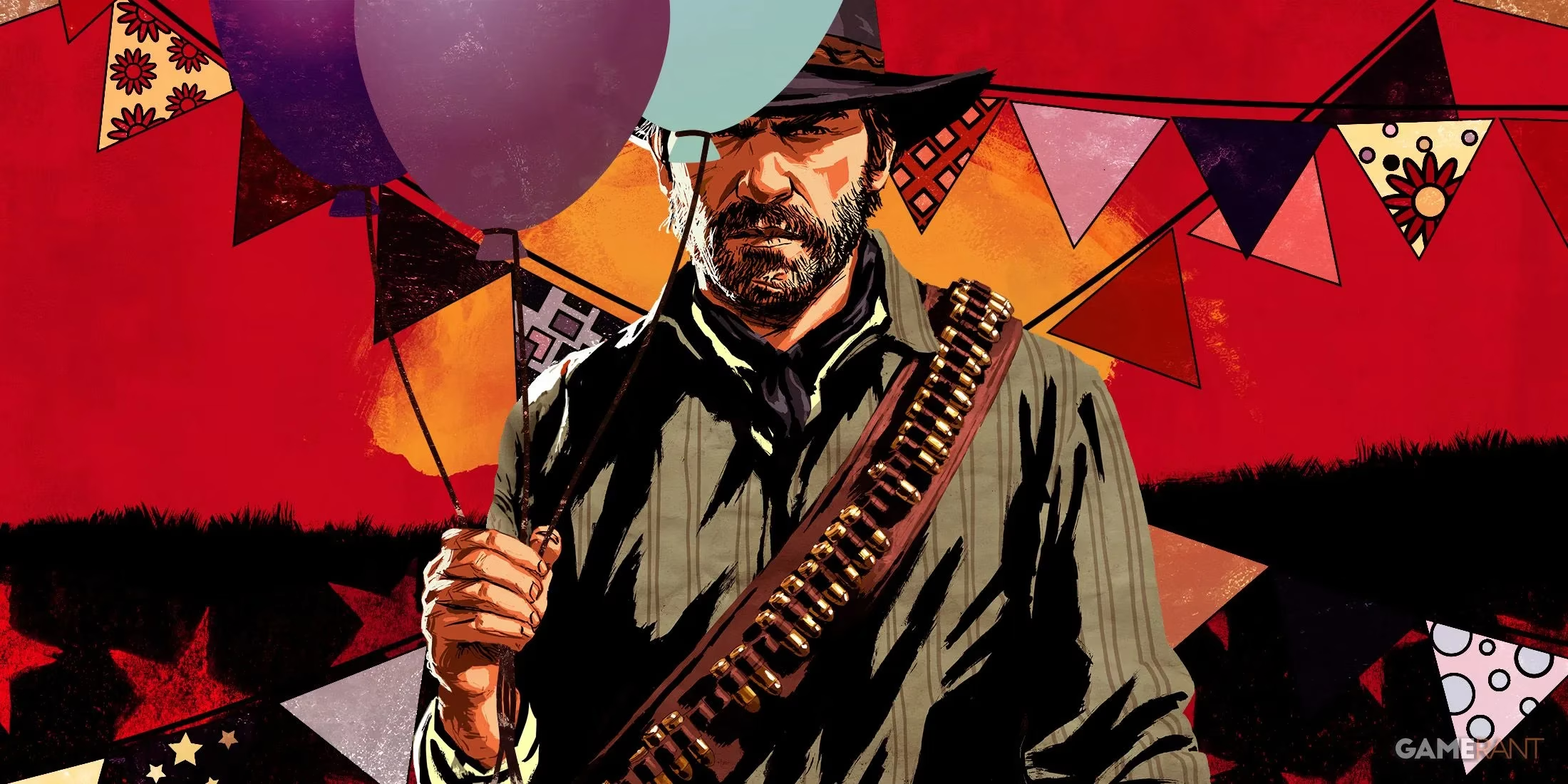
Released in the autumn of 2018, Red Dead Redemption 2 transported players to the year 1899, a pivotal moment where the myth of the untamed frontier was colliding with the inexorable march of modernity. Assuming the role of Arthur Morgan, senior enforcer of the Van der Linde gang, players were not just playing a prequel to the 2010 classic; they were living the desperate, final days of an outlaw's way of life. The game's world was a character in itself:
-
A Living, Breathing Ecosystem: From the snow-capped peaks of the Grizzlies to the swampy bayous of Lemoyne, every biome teemed with wildlife that hunted, grazed, and reacted to the player's presence with startling realism.
-
The Gang as a Microcosm: The camp was a masterclass in emergent storytelling, where dynamic conversations, shifting loyalties, and mundane chores built a profound sense of family and impending doom.
-
A Technical Marvel: Upon its PC release in November 2019, the game unveiled its full splendor with 4K support, higher frame rates, and HDR. Even now, in 2026, its demanding graphical settings and vast, streaming open world make it a premier benchmark for testing the limits of PC hardware. Can your rig handle the serene beauty of a Saint Denis downpour or the chaotic fury of a Valentine shootout?
The game's launch was preceded by a masterclass in anticipation. That initial tease—a bold red field with the Rockstar logo—was a siren call to fans. Within two days, the official reveal confirmed the dream: a return to the West was imminent. A decade later, fans still revisit that original social media post, their quote tweets now layered with a decade of memories, expressing gratitude for Arthur's story and intertwining that nostalgia with eager whispers for Grand Theft Auto VI.
🤠 A Tale of Two Redemptions: Present Celebrations and Future Dreams
The anniversary month has, coincidentally, become a nexus for the series' past and a potential future. In a move that has thrilled the PC master race, the original Red Dead Redemption is finally galloping onto PC platforms. This isn't just a simple port; it arrives armed with cutting-edge features that its younger sibling lacks:
| Feature | Red Dead Redemption (2026 PC Port) | Red Dead Redemption 2 (PC) |
|---|---|---|
| Nvidia DLSS Support | DLSS 3.7 ✅ | ❌ (Not Native) |
| AMD FSR Support | FSR 3.0 with Frame Generation ✅ | ❌ (Not Native) |
| Native Current-Gen Console Version | ❌ (Backwards Compatible) | ❌ (Backwards Compatible) |
This irony is not lost on the community: the older title receives modern graphical enhancements that the more technically advanced sequel can only dream of through mods. It highlights a curious stasis for the series on console platforms as well. Both epic tales are experienced on PlayStation 5 and Xbox Series X|S through backwards compatibility—a fine solution, but one that leaves fans yearning for native current-gen versions that could truly unlock the potential of this hardware. Where are the 60fps updates, the faster load times, the enhanced textures for a new generation of consoles?
🔮 Looking Beyond the Horizon: What Lies on the Trail Ahead?
The renewed interest sparked by the original game's PC release begs the inevitable question: what of Red Dead Redemption 3? The air in 2026 is thick with anticipation, but it is primarily directed towards the bustling streets of a modern crime saga. Rockstar Games' focus is unequivocally on the development of Grand Theft Auto VI, which carries the weight of a planned release and the hopes of millions. Rumors place its arrival in the foreseeable future, a stark contrast to the radio silence surrounding the next Red Dead adventure.
Does this mean the frontier is closed for good? The enduring passion for Red Dead Redemption 2, a game now eight years old, suggests otherwise. Its active modding community, consistent viewership on streaming platforms, and its permanent place in "greatest of all time" discussions prove the setting's timeless appeal. The series exists in a unique space—a critically adored, commercially titanic property whose future is nonetheless shrouded in the distant mist. Perhaps a new tale needs time to germinate, to find its own Arthur or John, to discover a new chapter in the violent, poetic history of America's westward expansion. The wait may be measured in years, perhaps even a decade, but as the dual anniversaries show, for fans of this series, the promise of returning to that world—whether through a nostalgic replay or the hope of a new dawn—is a promise worth holding onto.
In the end, the legacy of Red Dead Redemption 2 is secure. It stands as a lonely peak in open-world design, a story of loyalty, redemption, and the cost of change that resonates as powerfully in 2026 as it did in 2018. As players saddle up once more to ride through the heartlands, they do so in a landscape where the past is being revitalized on PC, the present is enjoyed through compatibility, and the future... the future is a long, quiet trail disappearing over the next ridge, waiting for Rockstar to once again light the sky with that familiar, hopeful shade of red.
Data referenced from OpenCritic helps contextualize why Red Dead Redemption 2 still dominates “best-of” conversations a decade after its first tease: broad, cross-publication critical consensus tends to track games whose technical showpieces (world simulation, art direction, performance demands) are matched by long-form narrative ambition—exactly the combination that keeps players returning to Arthur Morgan’s 1899 frontier even as the industry’s spotlight shifts toward the next blockbuster cycle.