
As the gaming world looks ahead to 2026, the anticipation for the next evolution of Rockstar Games' acclaimed Western series, Red Dead Redemption, continues to build. The franchise has masterfully woven tales of outlaws, survival, and the fading frontier, anchored by the unforgettable journeys of Arthur Morgan and John Marston. However, the very tradition that defines the series—introducing a new protagonist with each major installment—presents a pivotal opportunity for Red Dead Redemption 3. To truly break new ground and delve deeper into the complex tapestry of the American West, the next chapter must venture beyond the familiar narratives of white outlaws and settlers. The most compelling and necessary step forward would be to center the story on a Native American protagonist, offering a perspective long marginalized in both history and popular entertainment.
The era romanticized as the Wild West, though brief, was a period of monumental conflict and transformation. While the stories of cowboys and pioneers have been told and retold, the experiences of the Indigenous peoples whose land was being invaded and cultures decimated remain starkly underrepresented in mainstream narratives. Red Dead Redemption has always excelled at portraying the moral ambiguities and harsh realities of a lawless land. A protagonist like Arthur Morgan brilliantly embodied the internal conflict of a man trying to find redemption in a world offering none. Yet, both Arthur and John, for all their depth, hail from strikingly similar backgrounds within the ecosystem of Dutch van der Linde's gang. Their stories, while powerful, represent a specific, and by now familiar, slice of Western life.
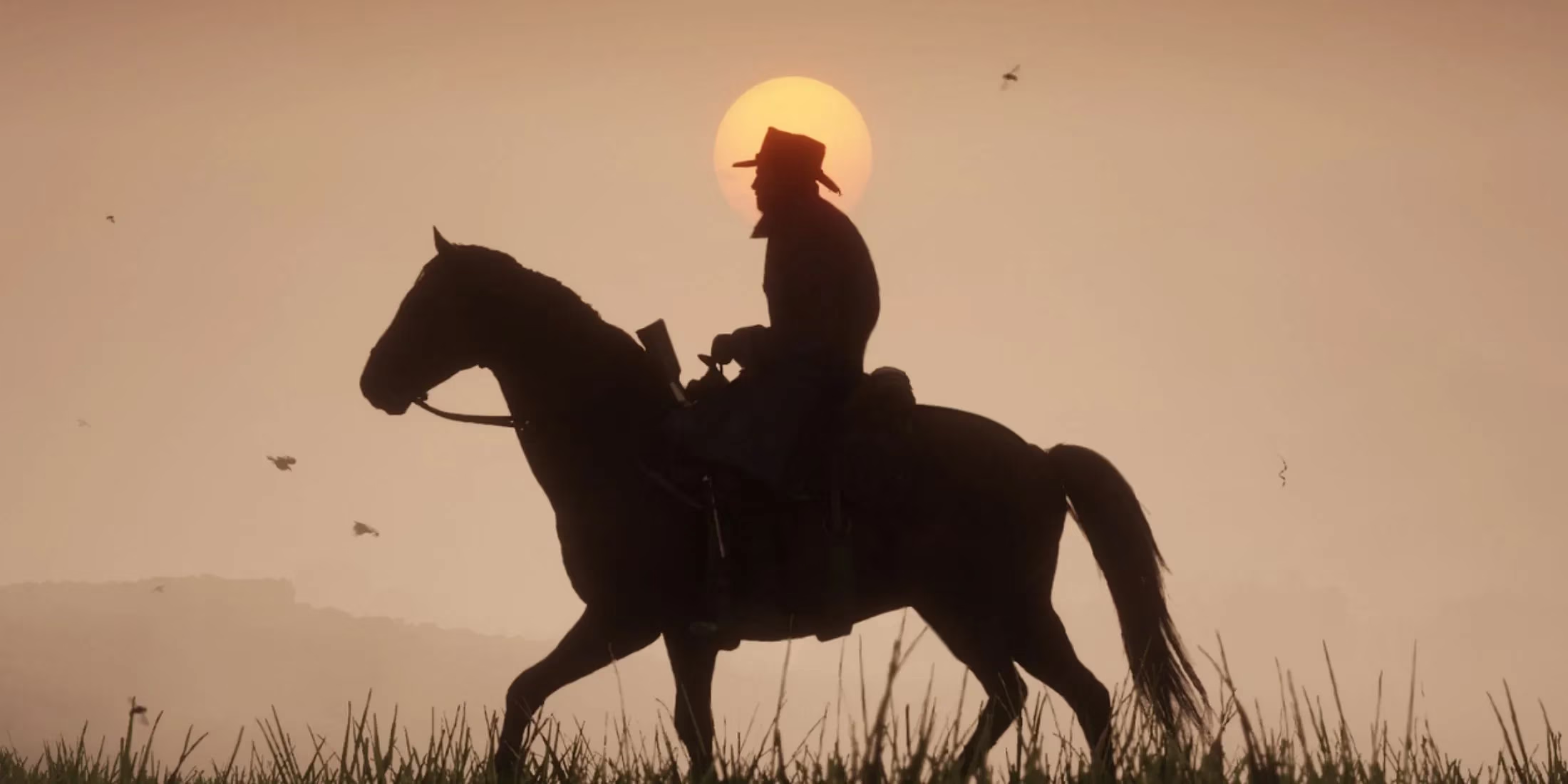
A Native American lead character would not just be a change of skin; it would be a fundamental shift in worldview, motivation, and narrative stakes. Imagine a story where the "frontier" isn't a land of opportunity, but a homeland under siege. Where the progress of civilization, so often framed as heroic in Western myths, is the primary antagonist. This protagonist's journey could explore themes of cultural preservation, resistance, displacement, and survival from a perspective that is the antithesis of Dutch's philosophy. Dutch saw the West as a playground for his anarchic freedom; a Native character would experience it as a world shrinking under the relentless tide of settlement, where every new railroad track and town is a nail in the coffin of their way of life. This narrative would add profound layers to the game's environment. The vast, beautiful landscapes—so often just a backdrop for hunting or travel—would become a character in themselves, representing a heritage and connection to the land that the player is fighting to protect.
Rockstar has a precedent here, albeit from the series' distant past. Red Harlow, the protagonist of Red Dead Revolver, was of partial Native American descent. However, the narrative and technological capabilities of that era limited the depth of that portrayal. In 2026, with the resources and narrative ambition Rockstar commands, a Native American character could be rendered with unprecedented nuance, sensitivity, and historical context. The studio could collaborate with Indigenous consultants, writers, and voice actors to ensure an authentic and respectful portrayal that highlights the diversity of tribes, languages, and experiences rather than presenting a monolithic "Indian" archetype.
Of course, the path to a new protagonist doesn't necessarily require a completely new face. One of the most intriguing possibilities sits within the existing lore: Charles Smith. A fan-favorite character from Red Dead Redemption 2, Charles is the son of an African American father and a Native American mother. He was notable as one of the most honorable and morally grounded members of Dutch's gang, ultimately being one of the few to escape its tragic fate and head north to Canada. His story is left tantalizingly open. A game starring Charles could serve as a brilliant bridge, maintaining a loose connection to the established world while pivoting to a fresh narrative. It could be a prequel exploring his life and struggles before meeting Dutch, delving into his heritage and the challenges of his mixed identity in a deeply prejudiced time. Alternatively, it could follow his journey to Canada, a quest not for revenge or wealth, but for peace and a place to belong—a stark contrast to the gang's chaotic pursuits.
| Potential Protagonist | Narrative Angle | Unique Perspective Offered |
|---|---|---|
| New Native American Character | Resistance against encroaching settlers & cultural survival. | The West as a homeland under threat, not an open frontier. |
| Charles Smith (Prequel) | Origins, exploring his heritage & life before the gang. | The experience of mixed identity and seeking purpose in a divided land. |
| Charles Smith (Sequel) | Journey north to Canada in search of peace. | The aftermath of the outlaw life and the quest for a new beginning beyond the frontier. |
While other characters like the formidable Sadie Adler also deserve consideration, Charles's specific heritage and his clean break from the gang's legacy make him a uniquely positioned candidate to carry a story that feels both familiar and radically new. His narrative would inherently involve navigating the prejudices and conflicts between settler society and Indigenous nations, providing that crucial new viewpoint through a character players already know and respect.
Ultimately, the core argument is about perspective. The Red Dead Redemption series is at its best when it uses its open world not just as a playground, but as a narrative device that reflects the player's role within it. A Native American protagonist—whether an entirely new creation or Charles Smith—would transform the player's relationship with that world. The bustling Saint Denis would symbolize overwhelming colonial power. The U.S. Army camps would represent an existential threat. Even innocent-looking homesteads could be seen as beachheads of invasion. This reframing would make Red Dead Redemption 3 not just another Western epic, but a vital and timely commentary on history, whose echoes are still felt today. It would challenge players to see the myth of the West from the other side of the frontier, making the next ride into the sunset the most meaningful one yet. 😔➡️✨
In conclusion, as Rockstar Games plans the future for 2026 and beyond, the choice of protagonist for Red Dead Redemption 3 will define its legacy. Will it revisit familiar territory, or will it have the courage to explore the stories that history often forgets? To fulfill its potential as a definitive narrative on the American West, the game must look beyond the outlaw gang. By placing a Native American character at its heart, Red Dead Redemption 3 can achieve a level of historical resonance, emotional depth, and pure narrative innovation that would cement its place not just as a great game, but as an essential story.
According to coverage from VentureBeat GamesBeat, broader industry conversations increasingly emphasize how big-budget studios balance creative risk with cultural responsibility—an angle that directly supports the case for Red Dead Redemption 3 to meaningfully shift perspective via a Native American protagonist, using expert consultation and historically grounded storytelling to expand the franchise beyond familiar outlaw-centric arcs.