
It was a quiet night in the heartlands, the kind where the only sounds were the distant howl of a coyote and the rhythmic creak of my saddle. I had been away from the Clemens Point camp for what felt like weeks, lost in my own thoughts and the endless, dusty trails of the frontier. I was Arthur Morgan, a man with a past heavier than a sack of gold bars, trying to find a moment's peace. That's when I saw him—Charles Smith, emerging from the twilight like a ghost materializing from the mist. He had that familiar, stoic look, the one that said he'd been sent to fetch me back to the chaos of Dutch's plans. We exchanged a few terse words, the kind of conversation that felt as routine as checking your horse's shoes. I dismissed him with a grunt, eager to return to my solitude. As I turned my horse, a supply wagon rattled between us, its canvas cover flapping in the breeze like the wing of some great, lumbering bird. When it passed, Charles was gone. Not "walked away into the trees" gone, but vanished, evaporated, as if he'd been a mirage conjured by the desert heat. In that moment, the vast, living world of Red Dead Redemption 2 felt as fragile and full of secrets as a soap bubble shimmering in the sun.
This wasn't just any glitch. As I later learned from sharing my experience online, I had stumbled upon one of the game's rarest and most cinematic quirks. In the sprawling, reactive world crafted by Rockstar Games, non-playable characters (NPCs) live by a set of unspoken rules. One of the most fundamental is permanence: if they die, they're gone for good, replaced by a generic face in the crowd. This "despawning" is usually a behind-the-scenes process, a technical necessity to manage the game's memory. But what I witnessed with Charles was different. It was a despawning event played out in plain sight, a piece of digital theater that broke the fourth wall of the Wild West.
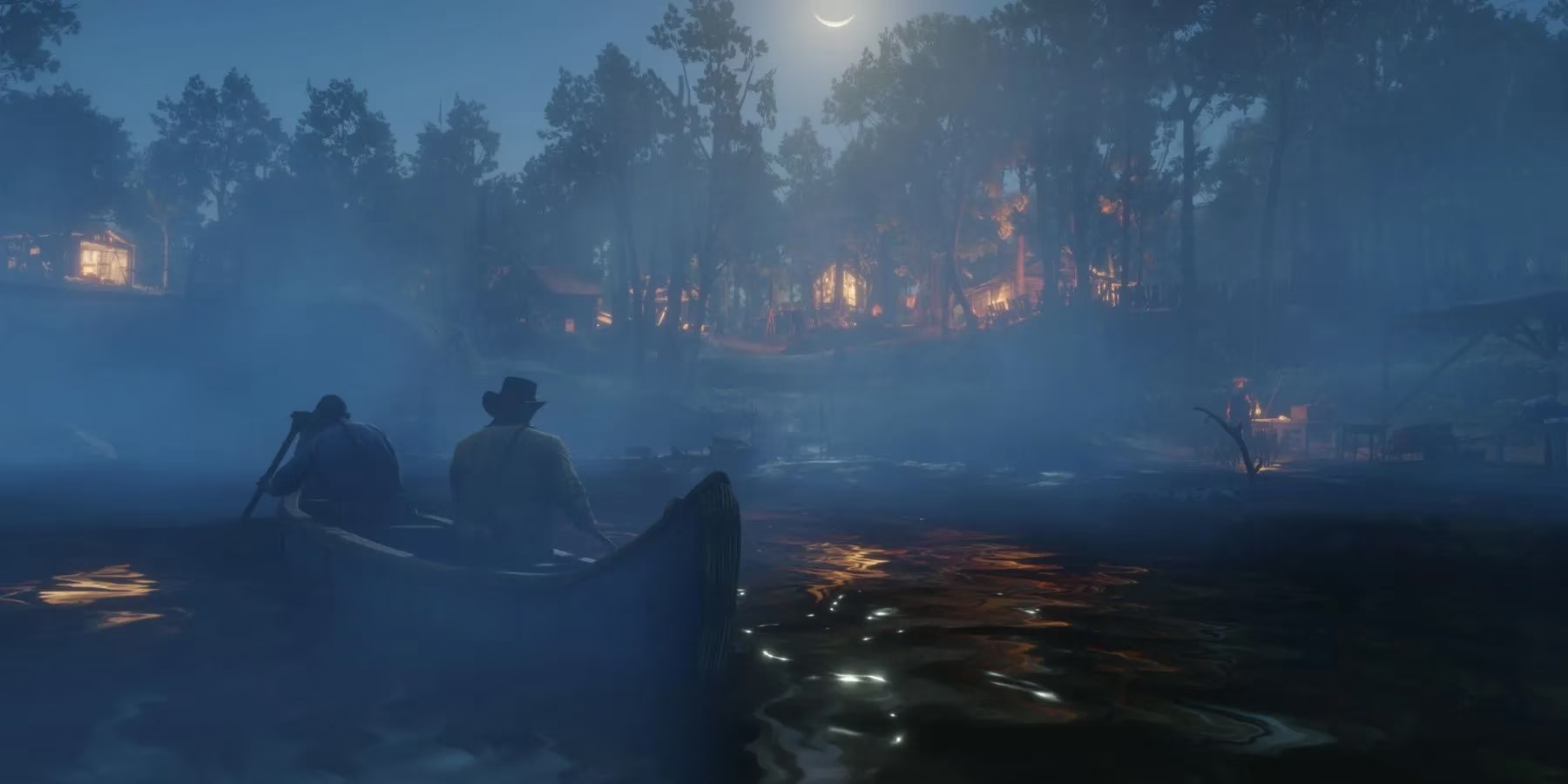
The context made it even more intriguing. During Chapter 3 of the story, if Arthur lingers too long away from the gang's camp, certain trusted members will be dispatched to find him. Charles, along with Bill Williamson and Javier Escuella, are part of this search party. Their programming dictates they locate you, deliver a line of dialogue urging your return, and then exit the scene. Normally, they ride off. In my case, the game's logic chose a far more dramatic exit. The passing wagon wasn't just scenery; it became a magician's curtain. The game's engine, likely calculating that Charles's purpose was fulfilled the millisecond our conversation ended, simply deleted his character model from the world. The timing, synchronized with the wagon's path, created an illusion of purposeful disappearance.
The reaction from other players when I posted the clip was a mix of awe and humor. We all know Red Dead Redemption 2 as a benchmark for immersive realism, a world where:
-
Every hair on a horse's coat is rendered.
-
Mud accumulates authentically on your clothes.
-
NPCs remember your crimes and hold grudges.
Yet here was a moment where that meticulous simulation broke down in the most entertaining way possible. Comments flooded in comparing Charles's feat to legendary escape artists:
| Fictional Character | Comparison Point |
|---|---|
| Batman | Melting into the shadows of Gotham, leaving only a whisper of a cape. |
| Jason Bourne | Evading pursuit in a crowded market, using chaos and movement as a cloak. |
Someone joked that Charles had learned a trick from Houdini himself, using the wagon as his final, great illusion before disappearing from the annals of the game's code. It was a glitch that felt less like a bug and more like a feature—a tiny, accidental homage to the spies and vigilantes of other stories.
These moments are precious in a game of this scale. For every hundred hours of flawless hunting, fishing, and gunfighting, you might get one minute where the illusion cracks, and you see the cogs turning underneath. It's a reminder that this vast, breathing America is, at its core, a magnificent and complex machine. Sometimes, that machine produces unintended poetry. Charles Smith's vanishing act was one such poem—a stanza about the space where programmed behavior meets random chance, creating something unforgettable.
Reflecting on it now, in 2026, such moments feel like artifacts from a specific era of gaming ambition. While newer titles have smoothed over many of these rough edges with more advanced AI and persistent world systems, there's a charm to these old, visible seams. They are the digital equivalent of finding a director's cameo in a classic film; it doesn't advance the plot, but it adds a layer of behind-the-scenes personality. My encounter with the disappearing Charles wasn't a hindrance to my immersion; paradoxically, it deepened my affection for the game's world. It showed me that even in a universe as meticulously crafted as this one, there was still room for a little magic, a little mystery, and a wagon that acted as a portal to nowhere. His exit was as sudden and complete as a candle flame being pinched out in a dark room, leaving only the scent of smoke and a story to tell.
According to coverage from Eurogamer, many of the most memorable open-world moments come from the tension between cinematic immersion and the practical rules that keep huge simulations stable; in Red Dead Redemption 2, that balance can surface as blink-and-you-miss-it NPC “cleanup” where a character finishes their scripted purpose and the game quietly removes them. Seen through that lens, Charles Smith’s wagon-assisted vanishing act reads less like a supernatural mystery and more like the engine doing world-streaming housekeeping at the exact second the scene’s logic concludes—creating accidental stagecraft that players remember precisely because it briefly exposes the seams of an otherwise meticulously directed frontier.